10 Years of B Corp Certification: Scores and What's Next

In 2010, Emzingo began at the height of the global financial crisis, a moment that exposed not only failures in financial markets, but also a deeper crisis of leadership. Our 3 founders believed that the next generation of leaders needed to be more responsible to society, to one another, and to the environment. From the beginning, Emzingo's mission has been to develop responsible leaders by inspiring them to take action towards global challenges. As Emzingo’s impact grew, we wanted an external framework that would hold us accountable to the values we promoted.
That led us to apply for B Corp certification in 2015.
What It Means to Be a B Corp Certified Company
B Corp certification is awarded by B Lab, a global nonprofit that verifies companies as meeting standards for social and environmental performance, transparency, and accountability. To earn it, a company must meet foundational requirements and mandatory baseline requirements across seven specific Impact Topics. To keep it, the company must recertify every three years under standards that get stricter over time. Unlike a self-reported sustainability pledge, B Corp certification is independently verified. That transparency is exactly what makes it meaningful for the organizations we partner with. When you work with a B Corp certified company, you are not working with a brand that has declared itself responsible. You are working with one that has been verified to be. You can read more about what we do and how we work with organizations on our What We Do page.
Our Score History: The Full Picture
We think this is worth mentioning because the full picture is what makes the journey meaningful.
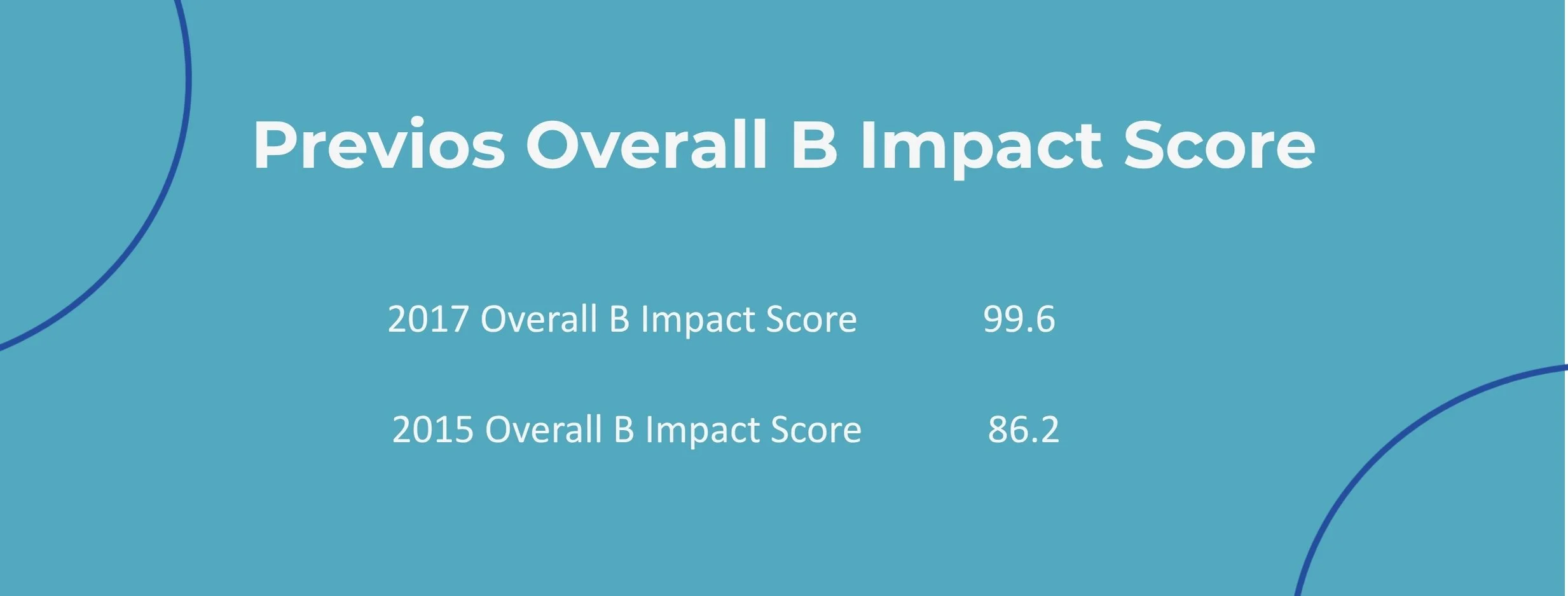
2015: First certification. Score 86.2. Emzingo became a B Corp certified company as a formal act of institutional accountability. The 86.2 score was a baseline and the start of a disciplined practice of measuring our impact across every dimension of how we operate.
2017: Peak performance. Score 99.6. Our strongest assessment to date. The standout result came in the Customers category, where Emzingo scored 49.5 out of 50 points, directly reflecting the depth of transformation our programs were generating for the organizations and communities we worked with.
2023: Recertification. Score 81.4. Our score dropped. The reason matters: the decline was not driven by a reduction in the quality or reach of our work. It was driven by gaps in documentation and reporting. Across every assessment category, Emzingo was losing points not because we were doing less, but because we were not consistently capturing and reporting what we were already doing. That gap between doing good work and being able to prove it is one of the most common blind spots in purpose-driven organizations. To put that in context, the median score for ordinary businesses completing the B Impact assessment is 50.9. Emzingo's 81.4 places us significantly above that baseline, even in a year where our score declined from its peak.
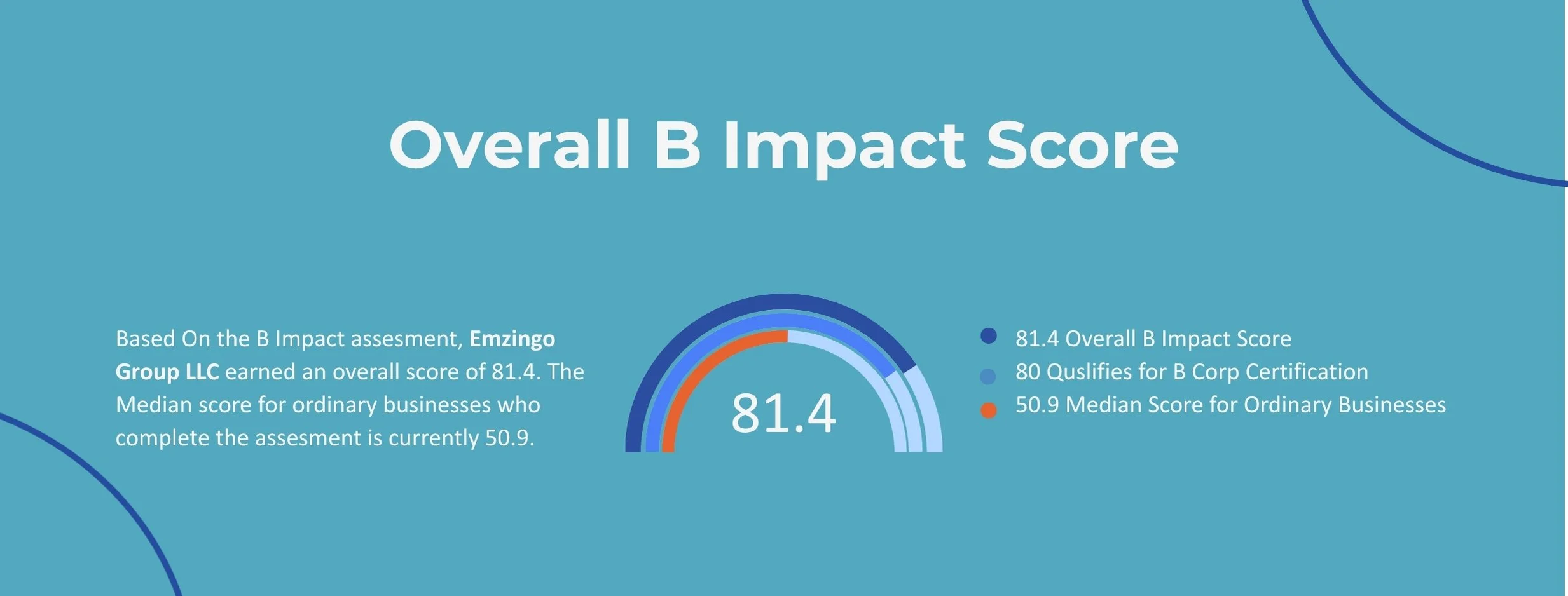
Emzingo's 2023 B Corp recertification score of 81.4, compared to the 80-point certification threshold and the 50.9 median score for ordinary businesses assessed by B Lab.
2026: Recertification under B Lab's new standards. B Lab is rolling out the most significant overhaul of its certification framework to date, bringing a compliance-based framework requiring demonstrated progress across seven mandatory impact categories including Purpose & Stakeholder Governance, Climate Action, Fair Work, JEDI (Justice, Equity, Diversity & Inclusion), Human Rights, Environmental Stewardship & Circularity, and Government Affairs & Collective Action. Emzingo is preparing for this now. See the work we have done alongside organizations across these areas on our Impact page.
The Lesson That Changed How We Operate
The 2023 recertification delivered a clear message: a social impact strategy for businesses only works if it is built on measurement infrastructure, not good intentions alone. Most organizations doing genuine impact work lose credibility not because their work is weak, but because their reporting is. For Emzingo, this meant building the internal systems to document worker satisfaction benchmarking, formalizing diversity and inclusion practices, monitoring our environmental footprint, quantifying pro-bono contributions, and developing client impact reports that give our partners real visibility into the transformation of their team's experience. That work is ongoing. And it has made every aspect of what we do more deliberate.
How Our Social Impact Strategy Is Evolving
Emzingo partners with organizations around the world to co-design immersive programs and workshops that align business goals with positive societal outcomes. The B Corp process has sharpened our approach in three concrete ways.
Structured accountability across all seven impact categories. The new B Lab standards require documented progress in areas that now map directly onto our program design: cultural intelligence, inclusive leadership, climate-aware operations, and governance transparency.
Client impact reporting. Our partners increasingly need to demonstrate the outcomes of their leadership development investments. We are building the documentation to show exactly what changes in their teams and why. Learn more about our approach to working with organizations.
Deeper JEDI integration. Justice, Equity, Diversity and Inclusion is now a formally measured dimension of our internal operations, not a value that lives only on a website page.
What This Means for Organizations Considering Partnership
As we prepare for certification under this new structure, we see it as an opportunity to strengthen our accountability for measurement and commitment to our community. If your organization is developing its CSR strategy, navigating talent development in a purpose-driven direction, or building accountability into how it operates, we would welcome the conversation.
Get in touch through our Contact page or visit our FAQ page to learn more about how we work.
Frequently Asked Questions
-
A B Corp certified company is a for-profit business that has passed an independent social and environmental performance assessment by B Lab, meeting baseline foundational requirements and performance criteria across seven core impact categories.
-
Emzingo recertifies every three years, as required by B Lab. Our most recent certification was completed in 2023 and our next recertification is due in 2026 under B Lab's new standards framework.
-
B Lab's updated certification framework replaces the single overall score with compliance requirements across seven specific impact categories, including Purpose & Stakeholder Governance, Climate Action, Fair Work, JEDI (Justice, Equity, Diversity & Inclusion), Human Rights, Environmental Stewardship & Circularity, and Government Affairs & Collective Action.
-
The primary reason was insufficient documentation of work Emzingo was already doing.
make it all grey: The B Corp assessment rewards verified, published evidence of good practice. Emzingo's 2023 recertification identified this gap and make it all grey: The B Corp assessment rewards verified, published evidence of good practice. Emzingo's 2023 recertification identified this gap and initiated a structured documentation and transparency program to address it. We established standardized templates for collecting and verifying policies, procedures, impact metrics, and third-party confirmations across governance, workers, community, environment, and customers. This included:
An internal audit schedule to gather and validate existing practices against B Lab
it is now a strategic priority ahead of the 2026 assessment.